 English
  Deutsch
  Español
  Italiano
  Български
  简体中文
简体中文  Polski
  Nederlands
  Dansk
Dansk  Svenska
  Français
  Português
  Ελληνικά
  Català
  Română
  Suomi
Suomi  Čeština
  Magyar
guides
Inventions Born From Disability That Changed Our World
The curb cut effect is the principle that designing for disability benefits everyone. Here are the everyday innovations that prove it — and what it means for how we design the web.
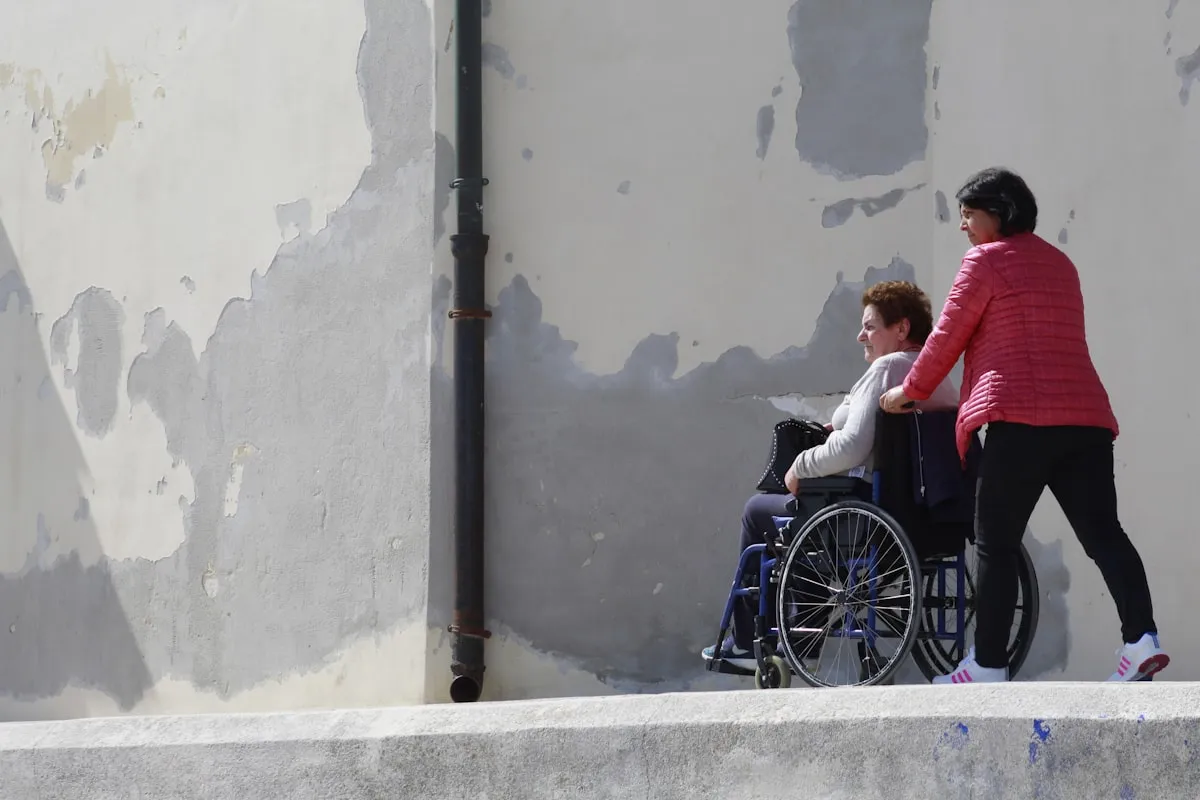
A lesson from the pavement
In 1972, activists in Berkeley, California poured concrete into street curbs overnight — an act of civil disobedience in response to the city’s failure to install ramped curb cuts that would allow wheelchair users to navigate the streets independently.
The curb cuts came. And something unexpected happened: everyone used them. Parents with strollers. Delivery workers with hand trucks. Travelers with rolling luggage. Elderly residents who found steep curbs difficult to navigate. The modification designed for wheelchair users turned out to make life easier for a significant portion of the population.
This became known as the curb cut effect: solutions designed to remove barriers for people with disabilities so often turn out to benefit everyone that it’s now recognized as a principle of universal design. Designing for the margins — for the people who face the greatest difficulty — tends to produce better solutions for the mainstream too.
The history of technology is full of examples. The following are some of the most consequential.
The innovations that curb cuts brought to life
The internet’s dominant communication form emerged partly through the work of Vint Cerf, co-inventor of the TCP/IP protocols. Cerf, who has significant hearing loss, was motivated by a desire for asynchronous communication that didn’t require a telephone — which, in the era before widely available TTY devices, was a barrier for deaf and hard-of-hearing people.
Text-based, asynchronous communication that people could send and receive on their own schedule became the infrastructure on which a trillion-dollar industry runs.
The typewriter
The first commercially successful typewriter was invented in the 1860s to enable blind or partially sighted people to write legibly. The Countess Carolina Fantoni da Fivizzano, who was blind, inspired Pellegrino Turri to create a machine that would allow her to correspond with him independently. The technology evolved over decades, became the defining office tool of the 20th century, and remains the template for how we interact with computers today.
Audiobooks
The Library of Congress launched a “Books for the Blind” program in 1931, producing recordings of books on vinyl records for blind veterans and other visually impaired readers. The technology evolved through cassette tapes and CDs to the streaming services of today. Audiobooks are now a mainstream entertainment and information format used by hundreds of millions of people who have no visual impairment at all — they simply prefer audio while commuting, exercising, or doing household tasks.
Closed captions
Captioning was developed in the 1970s through collaboration between the Caption Center (then at WGBH in Boston) and the U.S. Department of Health, Education and Welfare specifically to make television accessible to deaf and hard-of-hearing viewers. Line 21 closed captions became a broadcast standard.
Today, captions are turned on in gyms, airports, and restaurants. They’re used by the majority of people watching short-form video on social media in public spaces. They benefit language learners, people in noisy environments, and anyone who missed a word of dialogue. The feature built for deaf viewers is now part of how almost everyone watches video.
Predictive text
T9 (Text on 9 keys) and early predictive text were developed partly from research into alternative input methods for people who couldn’t type quickly or comfortably — including people with motor disabilities who used switch access or scanning input.
The underlying technology fed into the autocomplete and predictive keyboard features now universal on smartphones. Every time someone’s phone finishes a sentence suggestion, they’re using a technology tree that has roots in accessibility research.
OXO Good Grips kitchen tools
In the late 1980s, Sam Farber noticed that his wife Betsy, who had arthritis, struggled with standard kitchen peelers. He commissioned the design firm Smart Design to create kitchen tools with large, soft, non-slip handles. The result was the OXO Good Grips line, designed explicitly around the needs of people with arthritis or reduced grip strength.
OXO became a commercial phenomenon. The handles that were right for people with arthritis turned out to be more comfortable and easier to control for everyone. Good Grips didn’t occupy a niche disability market; they became the standard against which ordinary kitchen tools were judged.
Voice recognition
Substantial early investment in voice recognition technology came from the needs of users who couldn’t type — people with motor disabilities, blindness, or conditions like repetitive strain injury. Dragon Systems, one of the earliest commercial voice recognition products, was built around this use case.
Today, voice interfaces are how a billion people interact with their phones, smart speakers, and home automation systems. Siri, Alexa, and Google Assistant are the mainstream descendants of tools built for disability use cases.
Subtitles and descriptive video
Audio description — narration describing the visual content of television and film — was developed for blind and visually impaired viewers. Descriptive video services began in the U.S. in the 1980s.
Language learners use subtitles extensively. Audio description services are increasingly built into streaming platforms, not as a niche feature but as a standard option.
What the curb cut effect means for web design
The web is the largest space ever created for human communication and commerce. It is also, routinely, inaccessible in ways that exclude hundreds of millions of people — and that make the web worse for everyone.
Accessible web design isn’t accommodation for a minority. It is the application of the curb cut principle to digital environments:
- Sufficient color contrast is better for everyone using a phone in sunlight
- Clear, logical page structure helps everyone navigate and scan content, not just screen reader users
- Keyboard operability benefits everyone who prefers not to use a trackpad, or who has repetitive strain injury from mouse use
- Captions benefit everyone watching video in a sound-sensitive environment
- Plain language benefits non-native speakers, people reading quickly, and anyone trying to understand a complex topic for the first time
Every accessibility improvement you make to a website is, most likely, a usability improvement for a much larger group than you might initially imagine.
The companies that understood GDPR had this dynamic were the ones that built compliant systems people actually preferred — more transparent, more trustworthy, more respectful of user preferences. The companies that understand accessibility has this dynamic will build digital products that more people prefer for exactly the same reason.
If you’re ready to start making those improvements, run a free scan to see where your site currently stands.
Build a website that works for everyone